
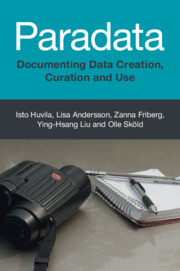
 To make sense of data and use it effectively, it is essential to know where it comes from and how it has been processed and used. This is the domain of paradata, an emerging interdisciplinary field with wide applications. As digital data rapidly accumulates in repositories worldwide, this comprehensive introductory book, the first of its kind, shows how to make that data accessible and reusable.
written and edited books

 Information Services and Digital Literacy is about the role of information services and digital literacies in the age of the social web. This title provides an alternative perspective for understanding information services and digital literacy, and argues that a central problem in the age of the social web and the culture of participation is that we do not know the premises of how we know, and how ways of interacting with information affect our actions and their outcomes. Information seeking is always a question of crossing and expanding boundaries between our earlier experiences and the unknown. We may not yet be well enough acquainted with the landscape of digital information to understand how we know, where the boundaries to our knowledge lie, how to cross them, and what consequences our actions may have.
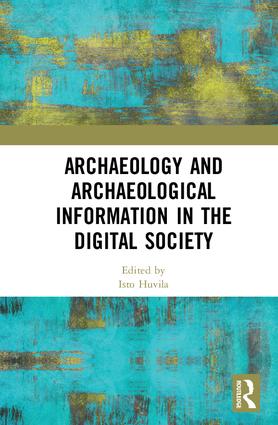
 Perspectives to Archaeological Information in the Digital Society
Forthcoming presentations
Latest Publications
What a Standard Makes out of a Process? Data-documentation Standards and Their Consequences to Process Documentation
Huvila, I., Sköld, O., Zengenene, D., & Andersson, L. (2026). What a Standard Makes out of a Process? Data-documentation Standards and Their Consequences to Process Documentation. Journal of Documentation, 82, 289–314. http://doi.org/10.1108/JD-10-2025-0324 (Original work published 2026)
Habitats of Archaeological Knowledge: From Information Ecologies to Information-in-Ecologies
Huvila, I. (2026). Habitats of Archaeological Knowledge: From Information Ecologies to Information-in-Ecologies. In N. Solhjoo (Ed.), Multispecies Information Science (pp. 201–220). London: Routledge. http://doi.org/10.4324/9781003583424-15
Documenting AI Use in Humanities Research
Huvila, I. (2025). Documenting AI Use in Humanities Research. In H. Verhagen, S. Tienken, A. Widholm, M. Fridlund, M. Nermo, & A. Blåder (Eds.), Huminfra 2025 (pp. 57–62). Stockholm: Stockholm University.
Letting AI Loose in an Archive: Technology to Manage or to Manage With
Huvila, I. (2025). Letting AI Loose in an Archive: Technology to Manage or to Manage With. Archiv, Theorie & Praxis, 75, 12–15.
Researchers Data Processing Descriptions–Understanding Paradata Creation Practices and Their Underpinning Instrumentalities
Huvila, I., Andersson, L., & Sköld, O. (2025). Researchers Data Processing Descriptions–Understanding Paradata Creation Practices and Their Underpinning Instrumentalities. Journal of the Association for Information Science and Technology, 76(11), 1570–1590. http://doi.org/10.1002/asi.70003
Latest toots
 |  |  |  |